
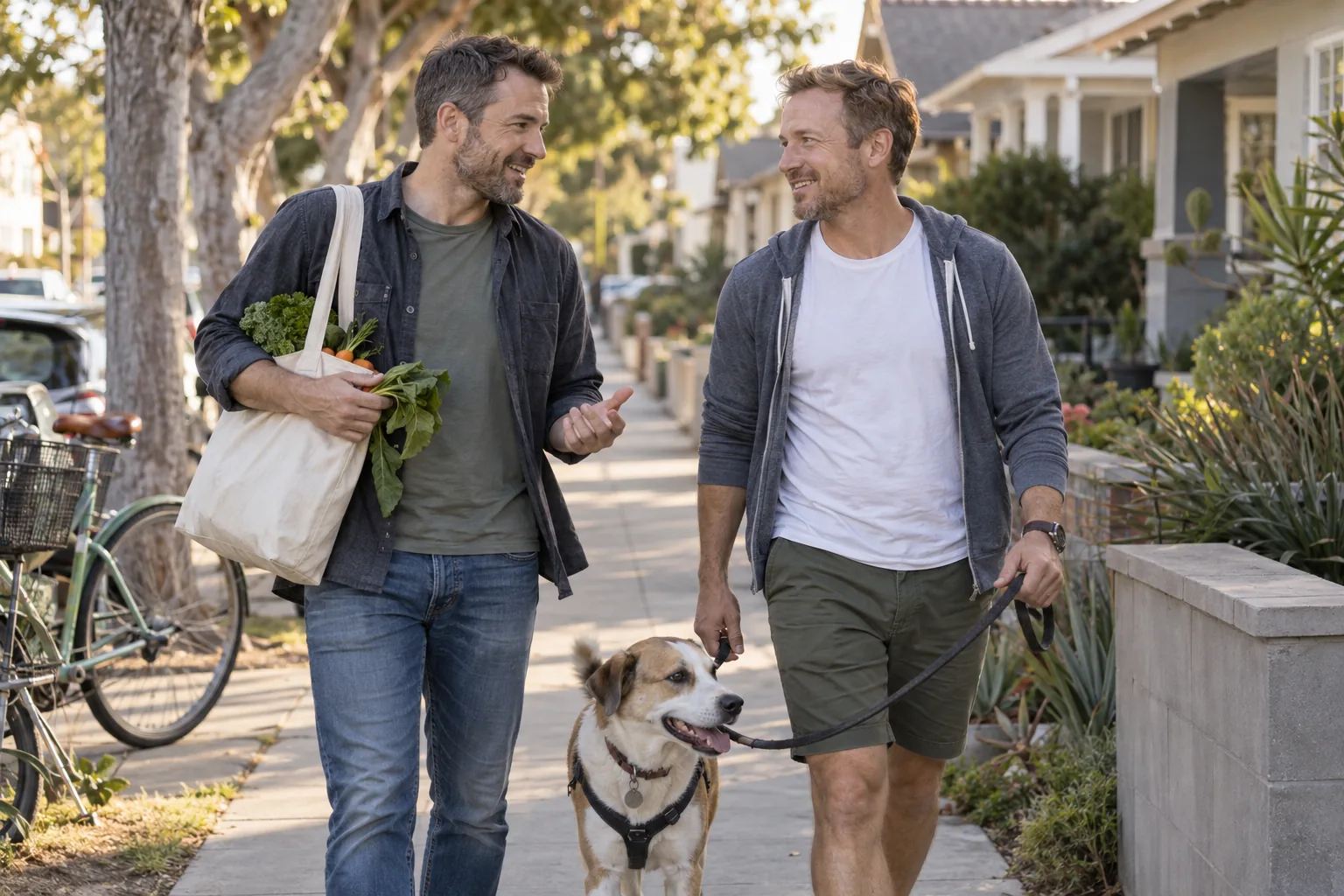
California can feel enormous until queer dating turns it into one small room. A new match knows someone from your climbing group. Their former roommate follows your coworker. You both go to the same Long Beach market, Oakland fundraiser, or Sacramento community event. Add HSV to that overlap and the dating question changes. Attraction still matters, but so do privacy, chosen family, and who gets to know which part of your story.
This guide is for lesbian, gay, bisexual, transgender, queer, nonbinary, and other LGBTQ+ adults dating with HSV in California. No single label creates one shared experience. The useful common ground is simpler: you should be able to date as a whole person, make informed choices, and keep personal health information out of community gossip.
The dating pool is not only smaller. It is more connected.
In a large city, two people may still share a gym, an ex, a volunteer project, or three mutual followers. In a smaller California town, an LGBTQ+ social circle can connect across work, family, nightlife, healthcare, and community groups. That closeness can feel supportive. It can also make one date seem public before either person has decided what it is.
Our view is that privacy should be discussed as early as the social overlap becomes clear. That does not mean opening with a warning. It can be one ordinary sentence: “I think we know some of the same people, so I like to keep dating and health conversations between the people having them.” A considerate person will understand the reason without asking for a list of secrets.
Notice the difference between being private and being hidden
Privacy lets you choose the audience and timing for personal information. Being hidden means another person wants the benefits of a relationship while refusing to acknowledge your existence. Those are not the same bargain.
Someone can avoid sharing your diagnosis and still introduce you to friends. They can post no couple photos and still make reliable plans. Watch whether the boundary protects both people or only protects one person from being seen with you.
Use the three-room test before sharing more
Think of early dating as three rooms. Information can move forward when trust grows, but it does not need to move everywhere at once.
The public room
This is the profile, the dating app, and anything a stranger could screenshot. It can hold your pronouns, the broad part of California where you live, a few interests, and the relationship pace you want. It does not need your exact workplace, daily route, legal history, former name, treatment details, or the names of people in your community.
A profile line with enough shape
“Queer, based in the East Bay, and happiest when Saturday includes a bakery stop and a trail with actual shade. I am open to a steady relationship and prefer getting to know someone without rushing our private lives online.”
That line gives a match something to answer. It also signals a privacy style without sounding guarded. If you want more help building the rest, use our California herpes dating profile guide.
The dating room
This room belongs to the two people exploring a connection. It is where HSV disclosure, sexual health, boundaries, relationship agreements, identity language, and personal history can be discussed. The door is consent. You decide what you are ready to share; the other person decides what information they need before intimacy.
The dating room should feel mutual. Having HSV does not make you the only person with something to disclose. Both people can talk about testing, protection, current partners, exclusivity, and what informed consent looks like for them.
The community room
This includes friends, chosen family, group chats, former partners, coworkers, and community spaces. Information does not enter this room merely because a date ended. A diagnosis is not a funny story, a warning passed around without context, or an explanation owed to mutual friends.
A useful rule: tell your own story. Before telling any part that identifies another person, ask whether you have their permission and whether the detail is actually necessary.
Chosen family can be close without becoming the dating committee
Chosen family may be the people who helped you through coming out, transition, divorce, illness, or rejection. Their opinions matter because their care is real. But early dating can become crowded when every message is reviewed by a committee.
Try giving a trusted friend the headline instead of the transcript: “I met someone I like, we have some overlapping circles, and I am moving carefully.” If you need support after an HSV conversation, talk about your feelings and choices without forwarding private messages or identifying the other person.
When a friend asks the question you do not want to answer
“I will tell you how I am feeling, but their health information stays with us.”
That sentence is not disloyal to a friend. It shows the kind of discretion you hope a future partner will offer you.
Do not turn identity and HSV into one giant disclosure
A person may be sharing their orientation, gender identity, pronouns, relationship structure, and HSV status at different times with different people. Combining everything into one high-stakes conversation can make it feel as if every part of you is on trial.
Separate the decisions. Ask what this person needs to know for the next stage of the relationship, what you want them to understand about you, and what can wait. A trans person may want to discuss language for their body before sexual contact while keeping medical history private. A bisexual person may correct an assumption without providing a relationship résumé. An HSV disclosure can be direct without becoming an explanation of your whole queer life.
A disclosure opener that leaves room to breathe
“I like where this is going. Before we get more physical, I want to share that I have HSV. I can tell you how I handle it, and I am comfortable giving you time to think or talk with a clinician.”
Then pause. You do not need to fill the silence with a defense of your desirability. Our fuller guide to disclosing herpes while dating covers timing, reliable health information, and follow-up questions.
California distance can change the size of an LGBTQ+ dating pool
“Nearby” has at least two meanings. There is map distance, and there is the amount of privacy, energy, and transportation a date requires. A match across Los Angeles may involve more travel than someone in another county. A Bay Area trip can be easy near BART and exhausting when the last connection disappears. Dating from an inland or rural community may mean driving farther for both a broader LGBTQ+ circle and more privacy.
Talk about the repeatable trip, not the heroic first trip. “I can meet in central San Diego on weekends, but weeknights need to stay in North County” is more useful than “distance does not matter.” If meeting closer to home risks running into coworkers or family, say that too. Privacy is a valid planning factor, but it should not leave the same person traveling every time.
Try the two-map question
Ask, “Where is easy for you, and where lets you relax?” Sometimes the answers are different. One person may have a convenient neighborhood cafe that is also full of colleagues. Another may prefer a place ten minutes farther away where they can focus on the date instead of scanning the room.
Choose a first date that does not require either person to perform
A queer venue can feel affirming, but it is not automatically private or comfortable. A general public venue can feel neutral, but it may not feel equally safe for every couple. Ask instead of assuming.
“Would you rather go somewhere queer-friendly where we might know people, or somewhere quieter where we can talk?” is a better question than choosing for both of you. A market walk, bookstore, museum courtyard, daytime cafe, or dog-friendly park can keep the plan simple. Arrive independently and agree on how long the first meeting will be. The California first-date privacy plan has practical venue and transportation checks.
If you run into someone you know
You do not need a cover story. A calm “We are grabbing coffee” is enough. Afterward, ask your date how the moment felt. That small check-in tells you whether future plans should use a different neighborhood or whether the overlap was no problem at all.
One person should not carry all the education
Curiosity is welcome. Interrogation is not. If a match needs general medical information, share one reliable source such as the CDC overview of genital herpes and encourage personal questions to go to a clinician. You can explain your own experience, but you do not have to become a lecturer, debate partner, or proof that every person with HSV has the same symptoms.
The same boundary applies to LGBTQ+ identity. A date can ask what language feels right for you. They should not expect you to teach an entire identity category before offering basic respect. A promising connection includes willingness to learn without turning you into homework.
If the answer is no and your circles still overlap
A rejection can hurt more when you expect to see the person at the same events. Agree on a neutral public line if needed: “We went out and decided not to continue.” No one else needs the health conversation behind that decision.
Give yourself permission to skip one event, change the time you go, or arrive with a friend. You do not have to abandon an entire community to protect someone else from mild awkwardness. If the rejection starts to feel like a verdict on your identity or diagnosis, our guide to recovering after herpes disclosure rejection helps separate one response from your larger story.
Look for community care in ordinary behavior
The best signal is not a perfect vocabulary. It is how someone behaves when a moment is slightly inconvenient. They ask how you want to be introduced. They do not tag your location without asking. They keep a private conversation private after deciding not to date. They correct a mistake without making you comfort them. They can learn something new without treating your life as a debate.
A good LGBTQ+ HSV dating connection does not require both people to share every label or experience. It requires enough care to hold complexity without turning it into gossip, secrecy, or a test. That is what makes room for the ordinary intimacy people are actually hoping to find: groceries after the market, a dog pulling toward the wrong block, someone remembering how you take your coffee, and a second plan that both people genuinely want to keep.
A practical next step
Write the next line of your profile
Begin with the life you want to share. Private details can wait for a private conversation.
Create Your ProfileOne useful draft
- A specific interest
- A realistic travel range
- A clear relationship pace