
Quick answer
Herpes dating after 40 is rarely about learning how to date from scratch. It is about making room for another person inside a life that already has shape: work, grown or nearly grown children, former partners, aging parents, a home, and a California commute that can eat half an evening.
The useful question is not “Can I still find someone?” It is “What kind of relationship can my real Tuesday, not my imaginary vacation life, support?” When you can answer that honestly, HSV becomes one important conversation rather than the organizer of the entire relationship.
After 40, every relationship runs on four clocks
Two people can have easy chemistry and still live on completely different clocks. One has a flexible remote job. The other opens a clinic at seven. One is available every other weekend. The other helps a parent on Saturdays. One can drive across the Bay after work. The other knows that a bridge crossing at the wrong hour will wipe out the evening.
Before treating that friction as lack of interest, look at four things separately.
| The clock | What it really asks | A useful early sentence |
|---|---|---|
| Time | When are you reliably free? | “Weeknights are tight, but I protect two weekends a month.” |
| Family | Who depends on you, and when? | “I help my dad on Saturdays, so Sunday plans are easier.” |
| Geography | What trip can you repeat without resentment? | “I can cross town on weekends, but not after work.” |
| Emotional pace | How quickly do you want lives to overlap? | “I like consistency, and I introduce family slowly.” |
This is one of our strongest opinions about dating after 40: calendar honesty is romantic. It prevents one person from mistaking exhausted availability for indifference and the other from promising time they do not have.
Use the Tuesday-night test before talking about forever
A profile can make almost anyone sound compatible on a sunny Saturday. The better test is an ordinary Tuesday. You both worked. Someone needs groceries. Traffic is bad. One person has a morning meeting. What kind of connection would still feel good?
Maybe it is a forty-minute dinner halfway between two neighborhoods. Maybe it is a phone call while each person walks the dog. Maybe weeknights are unrealistic, and the relationship needs a protected Sunday instead. None of those answers is more serious than another. The honest answer is the valuable one.
Ask about the week they actually live
“What does a normal week look like for you?” can sound like a job interview. Try something more human: “Which evening of your week still feels like your own?” Or, “When work gets busy, what kind of plan still feels enjoyable?”
Those questions reveal capacity without demanding a detailed calendar from someone you just met. They also make room for the unglamorous realities people often hide until date four.
A small scene that tells you more than a bucket list
Someone says, “On Wednesdays I pick up takeout, water the garden, and call my daughter.” That line tells you more about joining their life than “I love adventure.” You can picture the pace, the relationships that matter, and the amount of space still available.
Measure California distance by recovery time, not miles
Forty miles means something different at 10 a.m. on Sunday than at 5:30 p.m. on Thursday. Herpes dating after 40 in California works better when people stop using map distance as proof that a trip should be easy.
A Los Angeles match may be geographically close and still require ninety minutes each way. Someone in Oakland may enjoy dating in San Francisco but need the last BART connection to stay nonnegotiable. Sacramento and Bay Area dates can work beautifully for some schedules and feel like a second job for others. In San Diego County, “nearby” can still mean planning around long north-south traffic.
Name two dating radiuses
Create a weekday radius and a weekend radius. Your weekday radius is the trip you can make after a normal workday and still feel like yourself. Your weekend radius can be wider, but it should not quietly turn one person into the permanent driver.
A profile line might say, “I am in Pasadena and happiest with local weeknight plans. On weekends I am open to more of LA when we share the drive.” That sounds practical because it is. For a relationship that crosses regions, our guide to long-distance dating across California helps compare travel, money, hosting, and recovery time.
Give family honest headlines, not private details
Dating after 40 can involve teenagers at home, adult children who call often, or parents who have opinions about everyone. You do not need to hide that you are dating. You also do not owe anyone a new person’s diagnosis.
Use a privacy ladder. Early on, family gets the headline: “I have started seeing someone.” When the relationship becomes consistent, they may get a first name and a little context. Personal health information stays between the people who had that conversation unless both agree otherwise.
What to say when an adult child asks too much
“I am happy to tell you how the relationship is going. Their private health information is not mine to share.” This can feel stiff the first time you say it. It becomes easier when you remember that you are modeling the privacy you would want for yourself.
Do not make introductions carry hidden meaning
Meeting a son, daughter, or close friend should not be used as proof that disclosure went well or that the relationship is suddenly permanent. Introduce people when a pattern has formed, not because one emotional weekend made everything feel decided.
If children still live at home, talk about arrivals, overnight guests, and household privacy before anyone visits. The teenager who needs the kitchen at midnight is part of the real setting. Pretending otherwise does not make the relationship more spontaneous.
Look at how former partners occupy the present
Plenty of adults have an ex who remains in the picture through children, property, a business, or a long friendship. The existence of that person is not automatically a problem. Vagueness is.
Useful questions sound ordinary: “How do schedule changes usually work with your co-parent?” “Are you comfortable telling them you are dating?” “What parts of your past relationship are still being untangled?” You are not requesting courtroom documents. You are learning whether the current relationship has enough room to stand on its own.
Watch the pattern: “My ex is complicated” can explain one disrupted plan. It should not become a permanent pass for secrecy, late cancellations, or asking you to accept a relationship that only exists in leftover time.
Make HSV disclosure part of adult intimacy, not a confession
Many people over 40 have already had hard conversations about divorce, grief, caregiving, fertility, finances, or changing bodies. That experience does not make HSV disclosure effortless, but it can help you recognize what a good conversation feels like: direct, private, unhurried, and open to questions.
A natural opening can be short. “I like where this is going, and before we become more physical I want to talk about sexual health. I have genital herpes. I manage it with my healthcare provider, and I want you to have time to ask questions and decide what feels right.”
Then pause. You do not need to fill the room with every fact you learned after diagnosis. Use the CDC overview of genital herpes for general information, and let a qualified clinician answer personal medical questions. Our guide to disclosing herpes while dating offers several ways to choose timing and wording without turning it into a speech.
Do not blame every change in intimacy on HSV
Energy, stress, medication, menopause, erectile changes, pain, sleep, alcohol, and relationship history can all affect intimacy. Two adults deserve a conversation wide enough to include the whole body and the whole life. If something hurts, changes suddenly, or creates medical concern, take it to a clinician instead of guessing together.
Talk about what helps, not only what worries you
“I feel more relaxed when we plan private time instead of letting it happen at the end of a long date” is useful information. So is, “I need affection that does not automatically become sexual.” These are relationship preferences, not medical disclaimers.
Write a profile for the life you have now
The quickest way to make a 40+ profile feel generic is to borrow a younger version of yourself. If you no longer enjoy packed bars, say so. If you love live music but want a seat, that is a real preference. If your best weekend includes a hardware-store stop, lunch outside, and cooking at home, there is someone who will understand the appeal.
Replace résumé language with a doorway
“Established professional, family oriented, loves travel” is respectable and almost impossible to answer. Try this instead:
A profile opening
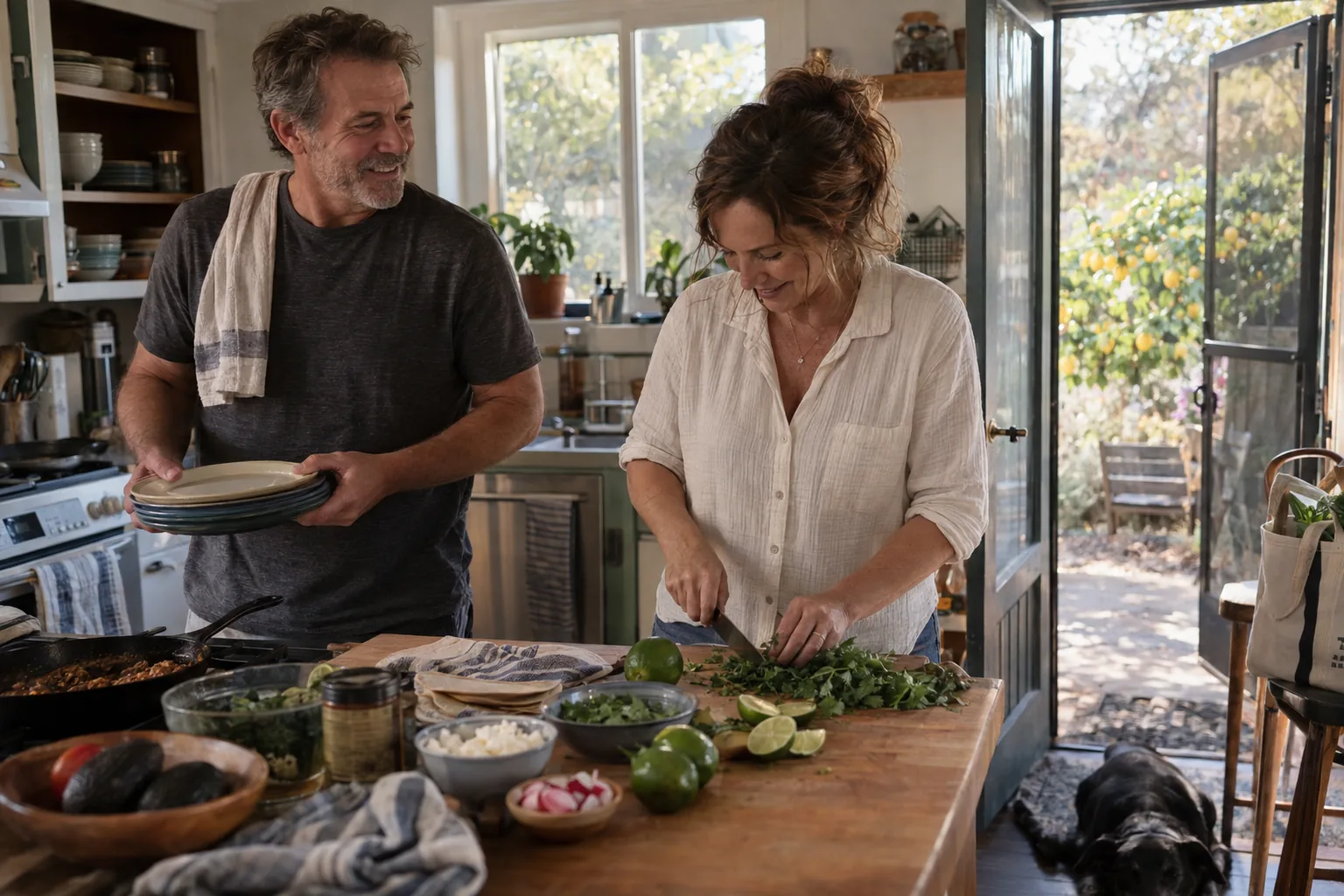
“My life is full, but not closed. I have grown kids, a ridiculous number of citrus trees, and a habit of making Sunday dinner for whoever is nearby. I am in the East Bay and prefer plans we can both repeat. Tell me the ordinary meal you make better than any restaurant.”
It shows family, place, pace, and an easy reply without sharing an address or private health detail.
The California profile-writing guide has more examples for building that kind of opening. Once the profile feels right, use one detail from another person’s page and the HSV dating first-message examples to start naturally.
Let the first three dates collect boring evidence
Excitement is easy to notice. The more valuable evidence is almost boring. Did they arrive when they said they would? Did they ask a question and listen to the answer? Could a plan change without becoming conflict? Did they respect a slower physical pace? Did you both make some effort?
One wonderful evening cannot answer all of that. Three ordinary dates begin to show a pattern. Choose settings that let the pattern appear: coffee and a walk, an early dinner, a bookstore, a neighborhood market, or a short event with a clear ending.
Keep your own way home
A home pickup can feel convenient, especially when driving distance is involved. It also reveals an address and removes some control over the ending. Meet in public and travel independently until sharing more feels earned. The California first-date privacy plan keeps that boundary warm and practical.
Treat home and money as intimacy, too
After 40, a home may carry decades of work, family history, pets, neighbors, and financial responsibility. Inviting someone in is not just changing the venue. It reveals where you live and how your private life works.
Talk before the first overnight stay. Who else has access to the home? Is an adult child likely to arrive? Does a pet sleep on the bed? Is there a separate way home if the evening changes? None of these questions is glamorous. All of them make relaxation more possible.
Money also deserves early plain language when dates involve travel or expensive plans. “I would rather keep early dates simple and split the larger plans” is enough. Generosity can be lovely. It should not buy control over time, travel, intimacy, or disclosure.
A rejection at 48 does not send you back to zero
Rejection after disclosure can hit old bruises from divorce, betrayal, or years away from dating. The mind quickly combines them into one story: “Here we go again.” Try to keep the events separate. This person made this decision now.
You still keep what you learned about timing, privacy, attraction, and your own ability to speak honestly. If the answer is sitting heavily, read our guide to recovering after herpes disclosure rejection before changing your entire profile or deciding everyone will respond the same way.
Do not rush toward the next match to prove a point
A new conversation should be allowed to become its own thing. If you are checking every reply for reassurance, take a few more days. Returning slowly is not lost momentum. It is how the next person avoids becoming responsible for what the last person did.
Choose the relationship that fits an ordinary Saturday
The real promise of herpes dating after 40 is not that life becomes simple. It is that you can stop pretending it is. You can name the drive you will make, the weekend you can offer, the family boundary you need, and the pace that keeps intimacy honest.
Look for someone whose ordinary life has a place for yours. Not every calendar will fit. Not every disclosure will end the way you hope. But when two people can cook dinner, handle an interrupted plan, protect each other’s privacy, and still want another Saturday, that is a relationship with something real to build on.
Start here: write three lines about a week you actually live, the California distance you can repeat, and one ordinary thing you would enjoy sharing. That profile will give the right person far more to respond to than a perfect list of qualities.
A practical next step
Write the next line of your profile
Begin with the life you want to share. Private details can wait for a private conversation.
Create Your ProfileOne useful draft
- A specific interest
- A realistic travel range
- A clear relationship pace